

Combating Sickle cell disease
— The world’s leading genetic disease —

Sickle cell disease is a serious chronic genetic affliction that is believed to affect more than 300,000 infants in sub-Saharan Africa each year. These figures motivated Fondation Pierre Fabre to join the fight against this little publicised disease in 2006.
________
Sickle-cell disease, the world’s most widespread genetic disease – particularly in Africa –, affects the haemoglobin, resulting in very painful, acute attacks and potentially fatal complications, especially in children.
Approximately 50 million people worldwide are carriers of sickle cell trait and therefore likely to transmit this genetic haemoglobin disorder to their offspring. This disease, emblematic of the populations of Africa and its diaspora, limits the life expectancy of those afflicted if they do not receive proper treatment: it is thought that half the children die before the age of five.
As a “neglected” and under-diagnosed illness, sickle-cell disease is a global health concern that is nevertheless not addressed by major international aid programmes. The Fondation Pierre Fabre has been dedicated to fighting this disease for over a decade, with several clear objectives: improve screening and treatment, train healthcare professionals and encourage research, while serving as a powerful advocate for those with sickle-cell disease to help make the illness a global health priority.
The Foundation is focusing its efforts on neonatal screening for the disease, an uncommon practice in Africa, and facilitating access to proper care. Starting with the Research Centre to combat sickle cell disease (CRLD) founded in Bamako, it intends to broadly disseminate the necessary skills for this battle elsewhere on the continent and in the Caribbean region, and forge effective South-South collaborations.
Robust data to support a general policy note:
In partnership with the CRLD in Mali, Inserm, Toulouse 3 University and the Fondation Mérieux, the Foundation financed and developed a scientific study to evaluate rapid screening tests for sickle-cell disease in newborns, compared with the current reference screening test for sickle-cell disease.
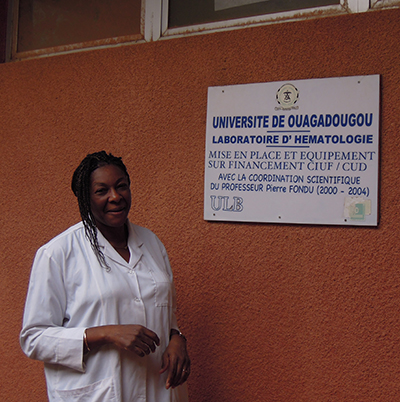

The fight against sickle cell disease is gaining structure and momentum.”
Pr. Éléonore KAFANDO
Medical biologist and professor of haematology at the Health Sciences UFR (training and research unit) at Joseph Ki Zerbo University in Ouagadougou, Burkina Faso
OUR PROGRAMMES

Prevention, diagnosis and treatment of sickle cell disease
The Foundation and the Sickle Cell Disease Initiative Committee in Burkina Faso implement a project of unprecedented magnitude in the country.

Creating and developing the Research Centre to combat sickle cell disease
The Center of Bamako, Mali, plays a fundamental role in the fight against sickle cell disease. It receives patients, conducts training and information campaigns and perform clinical research

Support for the Sickle Cell Research and Treatment Centre (CRTD)
The Fondation Pierre Fabre has been supporting the Bangui Sickle Cell Research and Treatment Centre (CRTD) since 2019. The CRTD is the country’s only referral institution and receives financial support for training and purchasing medicines and equipment.

Screening and management of sickle cell disease
The long-term objective is to sensitise governments to the benefits of a national programme combatting sickle cell disease, and having a viable and adaptable disease management model.

Support for the Sickle Cell Disease Control Centre
In Guinea, the Fondation Pierre Fabre supports the Sickle Cell Disease Control Centre in Conakry to help build the centre’s capacities and ensure its financial autonomy.

Supporting the fight against sickle cell disease in Sub-Saharan Africa
This multi-country project must address the major challenge of reducing morbidity and mortality linked to sickle cell disease by acting on several levels: Detect, treat, train, raise awareness and support public authorities

Support for the sickle cell treatment unit at the Centre Hospitalier Monkole
The Foundation helped build a paediatric unit dedicated to sickle cell disease housed in a new building of the hospital complex with precious help from Professor Léon Tshilolo

Supporting a programme to fight sickle cell disease
The Foundation choose to fund a programme centred on patient screening and care, medical staff training, opening a specialised centre and public education on sickle cell disease.

Strengthening management of sickle cell disease in Bangui
In 2011, pursuing the work already begun in Mali, Fondation Pierre Fabre became involved in the battle against sickle cell disease in the CAR.

Operational study on early detection and treatment of sickle cell disease
An operational study to measure the benefits of systematic neonatal screening and early treatment of the sickle cell disease in Senegal.

Improving healthcare and social services for those with sickle cell disease
The Foundation decided to invest in this major project over four years. The objectives are to reduce the mortality and morbidity related to sickle cell disease
Follow our action

An international webinar to launch a major report on the fight against sickle cell disease in French-speaking Africa
On Wednesday 22 April 2026, the Global Coalition Against Sickle Cell Disease organised a webinar dedicated to the official launch of its new report entitled ‘Combating Sickle Cell Disease: Initiatives and Prospects in French-speaking Africa’.

Meeting for a workshop on community mobilisation in Abidjan, Côte d’Ivoire
29 community leaders from 18 African countries, meeting for a workshop on community mobilisation on 24, 25 and 26 March 2026 in Abidjan, Côte d’Ivoire

Southern Lebanon: the Fondation Pierre Fabre takes action
The Fondation Pierre Fabre is funding the organisation of humanitarian convoys to provide an emergency response to the basic needs of residents in villages in southern Lebanon who are refusing to flee.